Fewwords V1 (Old) - AI content summarization that actually works
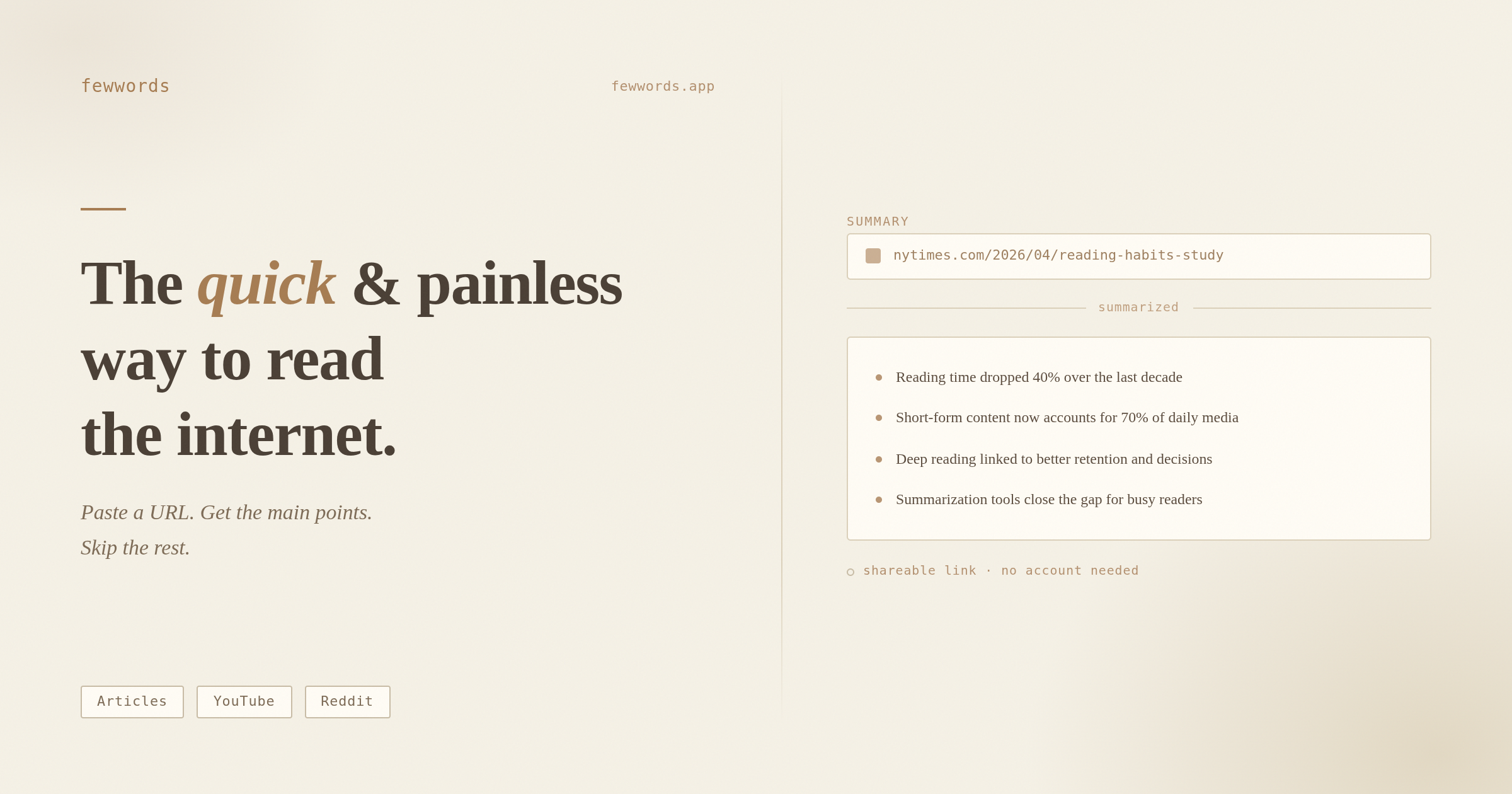
I have a confession: I can’t focus through long articles. And I definitely can’t sit through 2-hour videos. My attention span is short, and my browser was a graveyard of 47 open tabs I’d never actually read. We both know that “later” never comes.
For a year, my workflow was broken. Every time I wanted to extract the essence of a video, I had to hunt for a transcript tool, copy a wall of text, and paste it into ChatGPT with unreliable prompts. It worked, but it felt like too much friction just to save time.
So I built Fewwords. An AI-powered summarization tool for articles, YouTube videos, and Reddit threads.
First Attempt (And Why It Failed)
This wasn’t my first try.
In early 2025, I built a first version called Key-Insights. At the time, AI models weren’t capable of processing video natively. So I had to rely on brittle transcription scrapers that YouTube eventually blocked.
I hit a technical dead end and quit.
The Reality:
- Transcription scrapers kept breaking
- YouTube actively blocked them
- The AI couldn’t understand video content directly
- Eight months of work, unusable
Eight months of mistakes taught me what not to do.
Rebuild
By early 2026, the technology had caught up. New models like the Gemini 3 series became capable of watching and understanding video content directly. I rebuilt everything from scratch to use this new architecture.
What Changed:
-
Native video understanding: No more transcription scrapers. The AI watches the video directly.
-
Multi-stage classification engine: It doesn’t just “summarize.” It classifies content type and picks the right strategy:
- Structured: Essays, research, analysis
- Data Shot: Specs, tutorials, how-tos
- Decision Brief: News, reviews, updates
-
Three distinct pipelines: Dedicated paths for articles, short clips, and long-form video up to 3 hours.
-
Versioned prompt strategy: Custom prompts tuned for each content type, iterated against real outputs.
-
Real-time progress: Server-Sent Events (SSE) so users see progress as the AI processes long content.
Technical Stack
I would say the stack is pretty modern:
- Framework: Nuxt 4 with Vue 3
- Runtime: Bun (fast, simple)
- Database: PostgreSQL with Drizzle ORM
- Queue System: BullMQ with Redis for background processing
- AI: OpenRouter for multi-provider LLM access
- Auth: Passwordless Magic Link (simple, secure)
- Styling: Tailwind CSS v4
The architecture matters here. When you’re processing 3-hour videos, you can’t block the main thread. Everything runs through queues. Users get real-time updates via SSE. The database tracks job status. It’s built for actual load, not just demos.
Results
What works now:
- Paste a URL, get actionable bullets in 60 seconds
- Articles, YouTube videos, Reddit threads (with more coming)
- Shareable public links for every summary
- No account needed to create or read
- Free to start, credits system for heavy users
Performance:
- Background processing keeps the UI responsive
- Real-time progress updates via SSE
- Multi-provider LLM setup for reliability
- Queue system handles spikes without crashing
What I Learned
Sometimes the technology just isn’t ready. Key-Insights failed because I was building against the limits of 2025 AI models. I could have kept fighting scrapers and workarounds. But it made more sense to wait for the technology to catch up.
The second build took a fraction of the time and produced something actually usable. That’s the difference between fighting constraints and building with them.
Content classification isn’t a nice-to-have. It’s the core feature. The generic “summarize this” prompt produces generic garbage. Versioned, content-specific prompts produce something useful.
I’m not going to lie, I haven’t fully validated the demand for this yet. I built it because I needed it. If it helps you close even one tab today, then it was worth the effort.
Questions or feedback? Reach out.
