From Paddle Rejection to Polar Approval

I didn’t expect a payment gateway to feel like a job application.
But that’s exactly what it felt like.
Forms. Reviews. Waiting. Hoping someone on the other side says yes.
Except this time, I wasn’t applying to work for someone.
I was trying to get permission to run my own thing.
How this even started
I’m building small SaaS products under one umbrella:
SaaSy Thursday
The idea was simple. Not one big startup. Instead, a bunch of small, focused tools.
One of them is fewwords.
It’s a simple product. You give it long text. It gives you something shorter and easier to read. That’s it. Nothing fancy. Just useful.
Now, instead of creating separate legal setups for every product, I wanted one parent brand. One identity. One place for legal pages. One place for payments.
That’s why the umbrella exists.
Why I needed something like Paddle
When you’re outside the usual startup geography, things get tricky.
I’m in Pakistan. That means:
- No direct access to Stripe
- Limited global payment options
- Extra friction everywhere
So I looked at Paddle.
On paper, it solves everything:
- Handles payments
- Handles tax
- Handles compliance
- Acts as Merchant of Record
Basically, it becomes the “seller,” and you just build the product.
Perfect, right?
Preparing for approval
I didn’t go in blind.
I made sure everything looked right:
- Homepage? Done
- Products page? Done
- About page? Done
- Contact page? Done
- Pricing page? Done
- Terms? Done
- Privacy? Done
- Refund policy? Done
Everything existed. Everything had real content.
Even the small stuff:
- Footer links were there
- Refund email visible
- Paddle mentioned in legal pages
- Products listed (fewwords + others)
From a technical perspective, the site was pretty solid. I even deployed it properly. No localhost nonsense. Real domain. Real content.
Filling the application
The form itself was… long.
Personal details. Business details. Address. History.
Stuff like:
- “Age of business”
- “Trading name”
- “Have you ever been flagged for fraud?”
- “MATCH list?”
It felt like onboarding for a bank.
I filled everything honestly:
- Business start: May 2024
- Trading name: SaaSy Thursday
- No tax number (not required)
- No fraud history
Submitted. Done.
Now the waiting game.
The email
It came fast. Too fast.
And it wasn’t good.
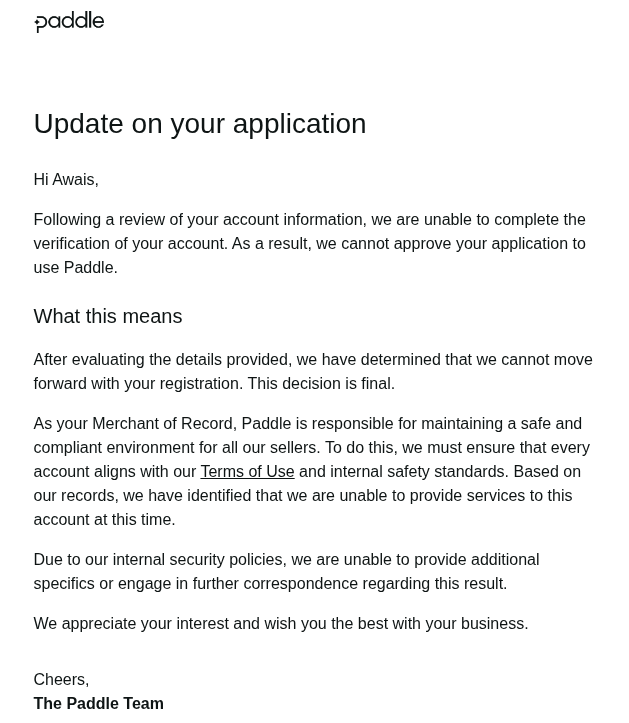
“We are unable to complete the verification of your account… This decision is final.”
No explanation. No feedback. No appeal.
Just… no.
That moment hits different
You sit there thinking:
- Did I mess up a field?
- Was my site broken?
- Is it because of my country?
- Is my product not good enough?
And the worst part? You don’t get answers.
So what actually went wrong?
After stepping back and looking at everything again, the issue wasn’t obvious at first. Because technically… everything looked correct.
But payment companies don’t just check structure. They check risk.
1. The umbrella problem
SaaSy Thursday had:
- Multiple products
- Different ideas
- Mixed stages
To me, that’s exploration.
To them, it can look like:
“This is not a stable business. This is a collection of experiments.”
And that matters. Because they’re responsible for refunds, chargebacks, fraud. So they prefer something simple: One product. One story.
2. No clear primary product
I knew fewwords was the main thing. But the site didn’t scream that. Instead, it showed fewwords, siftreader, other tools.
From their view:
“What exactly are customers paying for here?”
Unclear answer = risk.
3. Too clean, but no proof
Everything was set up properly. Legal pages. Structure. Content.
But there was no:
- user activity
- testimonials
- real traction
So it creates a weird signal. It looks like a finished business. But without evidence of being a real one.
4. Geography still matters
Let’s be real. Pakistan adds friction. Not impossible. But stricter review.
So your margin for error becomes smaller. Even small uncertainty can push you into rejection.
Could this have been approved?
Yeah. I think so.
If I had changed a few things:
Focus on one product
Make fewwords the entire story. Homepage = fewwords. Pricing = fewwords. No visible “portfolio of experiments.”
Simplify everything
Instead of:
“Indie studio building multiple tools”
Say:
“We sell a text summarization tool”
Boring works better here.
Show proof
Even basic things:
- a few users
- screenshots of usage
- real examples
Anything that says: “People actually use this”
Delay the umbrella
The umbrella idea isn’t wrong. Just too early. Payment platforms don’t like “potential.” They like “predictability.”
Switching to Polar
After that rejection, I moved to Polar.
Same idea. Merchant of Record. But different experience.
The onboarding
Honestly? It was fast.
Like surprisingly fast.
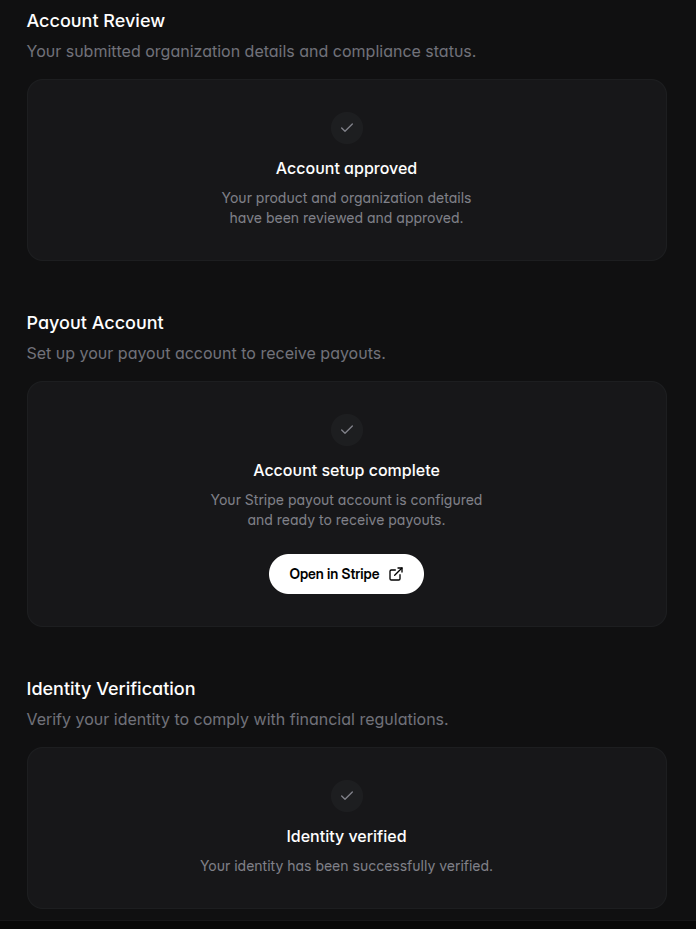
Three steps:
- Account + organization
- Stripe connection + bank
- KYC
Total time: around 30 minutes Actual effort: maybe 5 minutes
The only slow part was finding my SWIFT code. Everything else was smooth.
And then…
Approved.
No long wait. No rejection email. No drama.
Just done.
Why did Polar work?
A few reasons, I think:
- Newer platform
- More open to early-stage founders
- Slightly more flexible risk model
Also, timing matters. Sometimes it’s not just what you built. It’s who reviews it and when.
But approval is not the finish line
This part is important.
Approval just means: “You can start.”
Not: “You’re safe forever.”
There’s still monitoring:
- unusual transactions
- refunds
- spikes in activity
Everything is watched.
What I’m doing differently now
I’m keeping things simple.
- One product focus
- Clear pricing
- Small number of users first
No rush to scale.
Just making sure: The first few payments go smoothly.
Final thoughts
This whole process taught me something I didn’t expect.
Building the product is one thing.
Being allowed to sell it is another game entirely.
And no one really talks about that.
If you’re a solo founder reading this, especially from a place like Pakistan:
- Don’t assume “having everything ready” is enough
- Don’t assume rejection means failure
- Don’t wait for perfect setup before testing
Sometimes you just need to:
- adjust the story
- simplify the setup
- try a different platform
All right, so that’s where I’m at right now.
Fewwords is moving forward. Payments are working.
And yeah…
From applying to jobs
To applying to payment gateways
Same feeling.
Same wait.
Same hope.
But this time, it’s for something I’m building myself.
And that makes all the difference.
