The Solo Founder's Playbook: How to Find and Validate Ideas with $0
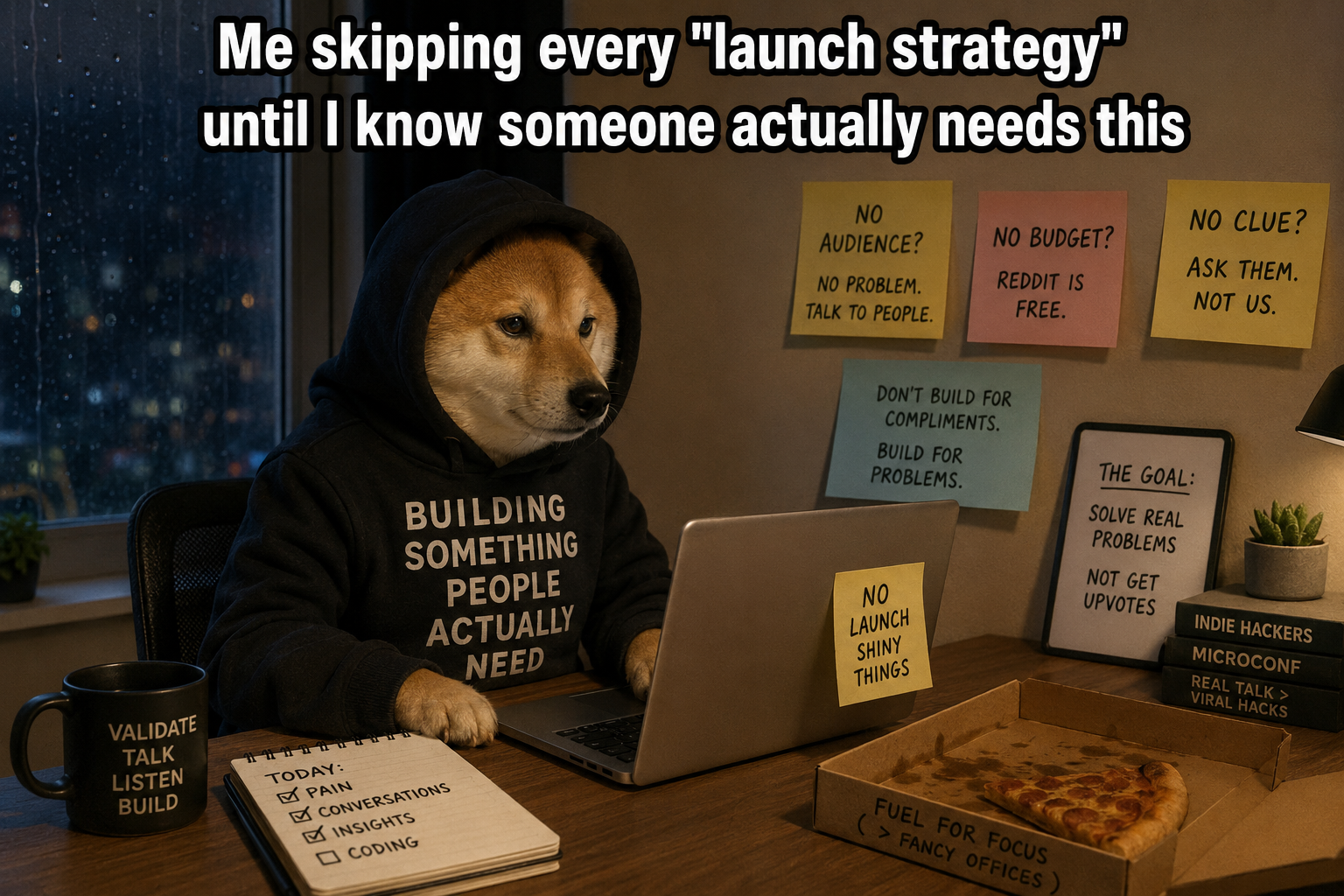
A few days ago, I was talking to a developer who was feeling stuck. She’d recently left a toxic remote job where she was grinding 16 hours a day. She was questioning if software engineering was even for her anymore.
I told her what I tell everyone who feels like the job market is dead: Build your own thing.
“But I don’t have an idea,” she said.
“Reddit is a gold mine,” I told her. “Find the pain there, build there, launch there.”
I promised her a playbook. A step-by-step guide for someone with zero budget, zero audience, and a laptop. No Silicon Valley “raise a seed round” fluff. Just the raw math of finding a problem people will actually pay to solve.
This is that playbook.
Most startup advice is dangerous for solo founders. If a guide tells you to “run Facebook ads to a landing page” or “hire a researcher,” close the tab. You don’t have $5,000 to burn on testing. You need a process that costs $0 and relies on your ability to listen and code.
Here is the 4-stage process to go from “I have no idea” to “I have 10 people ready to pay.”
Stage 1: Find Real Pain (3 to 5 hours)
Don’t look for ideas. Look for people complaining.
Go to Reddit. Not the founder subreddits. Everyone there is trying to sell you something. Go where the actual sufferers hang out. Search for these phrases directly:
- “I wish there was a tool that…”
- “Why is there no simple way to…”
- “I’ve been manually doing [X] and it sucks”
- “I can’t believe there’s no app for…”
- “Does anyone know a cheaper alternative to…”
Search Reddit-wide, not just in specific subs. Let the pain find you.
Your Goal: Collect 20 “Pain Statements.” Exact quotes from real people.
- “I spend 3 hours every week manually moving data from my CRM to a spreadsheet.”
- “Every invoicing tool I try is too complicated for a one-person business.”
- “I’m paying $200/month for a feature I only use once a week.”
If you don’t have 20 quotes, you don’t have enough data to move to Stage 2.
Stage 2: Pick One Idea (1 hour)
Run your 20 pain statements through these 5 questions. Score 1 point for every “Yes.”
- Do you personally understand this pain? (If you don’t get it, you’ll build the wrong thing.)
- Are people already paying someone else to solve it? (Competition is proof of a market.)
- Can you build a basic version in under 4 weeks? (If it takes 6 months, you’ll quit.)
- Is the customer easy to find online? (If you can’t find them now, you can’t sell to them later.)
- Will this problem still exist in 3 years? (Avoid trends.)
3 or more points = Worth validating. 2 or less = Skip it.
Don’t pick the “coolest” idea. Pick the one with the highest score.
Stage 3: Validate Before Building (5 to 10 hours)
This is where most developers fail. They get excited, open VS Code, and disappear for three months. Then they launch to silence because nobody actually wanted the thing they built.
Follow the 2-20-200 Rule:
- 2 hours: Research only. Search Reddit/Google to see if people are still complaining about this today.
- 20 hours: Conversations and a basic landing page. Still no code.
- 200 hours: Only now do you write serious code.
The “Sell it Before You Build it” Test
Write a 3-sentence description of what you want to build. Post it in the community where you found the pain.
“I keep seeing people struggle with [Problem]. I’m thinking of building a simple tool that does [One Feature] to solve this. Would that actually be useful to you? Genuinely asking before I build anything.”
Watch the reaction.
- Upvotes and “Please build this” replies: This is signal.
- Silence: This is also signal. It means the pain isn’t loud enough. Move to the next idea.
Stage 4: Talk to Real People
This is the scariest part for developers. Do it anyway.
Find 15 people who complained about the problem. DM them. Tell them you’re researching the issue and ask if they have 10 minutes to answer 5 questions.
The 5 Questions to Ask:
- What is your most painful and persistent problem with [Area]?
- How are you solving it today? (Spreadsheets? Manual work? Expensive tools?)
- What happens if you never solve it? (Does it cost them time? Money? Stress?)
- If you could wave a magic wand, how would you fix it?
- Would you pay for that solution, and roughly how much?
The Rule: Never mention your product idea until Question 5. Listen to their words. If 10 out of 15 people describe the same specific pain, you have your product roadmap.
What the “Gurus” Don’t Tell You
Most videos and books assume you have some “unfair advantage.” I’m assuming you have nothing.
- Skip the fancy landing page. Unless you have an audience or an ad budget, no one is coming to your site. Stay on Reddit, LinkedIn, or wherever your customers are.
- Build in Public = Build in the Community. “Building in public” on Twitter only works if you have followers. Building in public on Reddit (sharing your progress in the subs where the pain is) actually gets you users.
The Numbers That Matter
If you want to know if you’re on the right track, check these thresholds. They aren’t guesses. They’re the minimums for a solo founder.
| Milestone | Target |
|---|---|
| Pain statements collected | 20 minimum |
| Idea validation score | 3/5 questions |
| Reddit posts about the problem | 15+ in the last 12 months |
| ”Would use it” replies to your post | 5 minimum |
| Customer conversations | 15 minimum |
| People who said they’d pay | 3 minimum before building |
| MVP build time | Under 4 weeks |
My Take
I spent most of 2025 wasting time on “ideas” that I thought were cool but nobody wanted. I was treating my business like a coding project instead of a problem-solving project.
The idea doesn’t come first. The complaint does.
Go find your 20 pain statements. Don’t open VS Code until you’ve talked to 15 people.
This playbook was originally written for a developer in our community who was about to give up. If you’re in the same spot, I hope this helps you find your way back. Let me know how it goes.
