AI Is Not Tech, It's a Cult
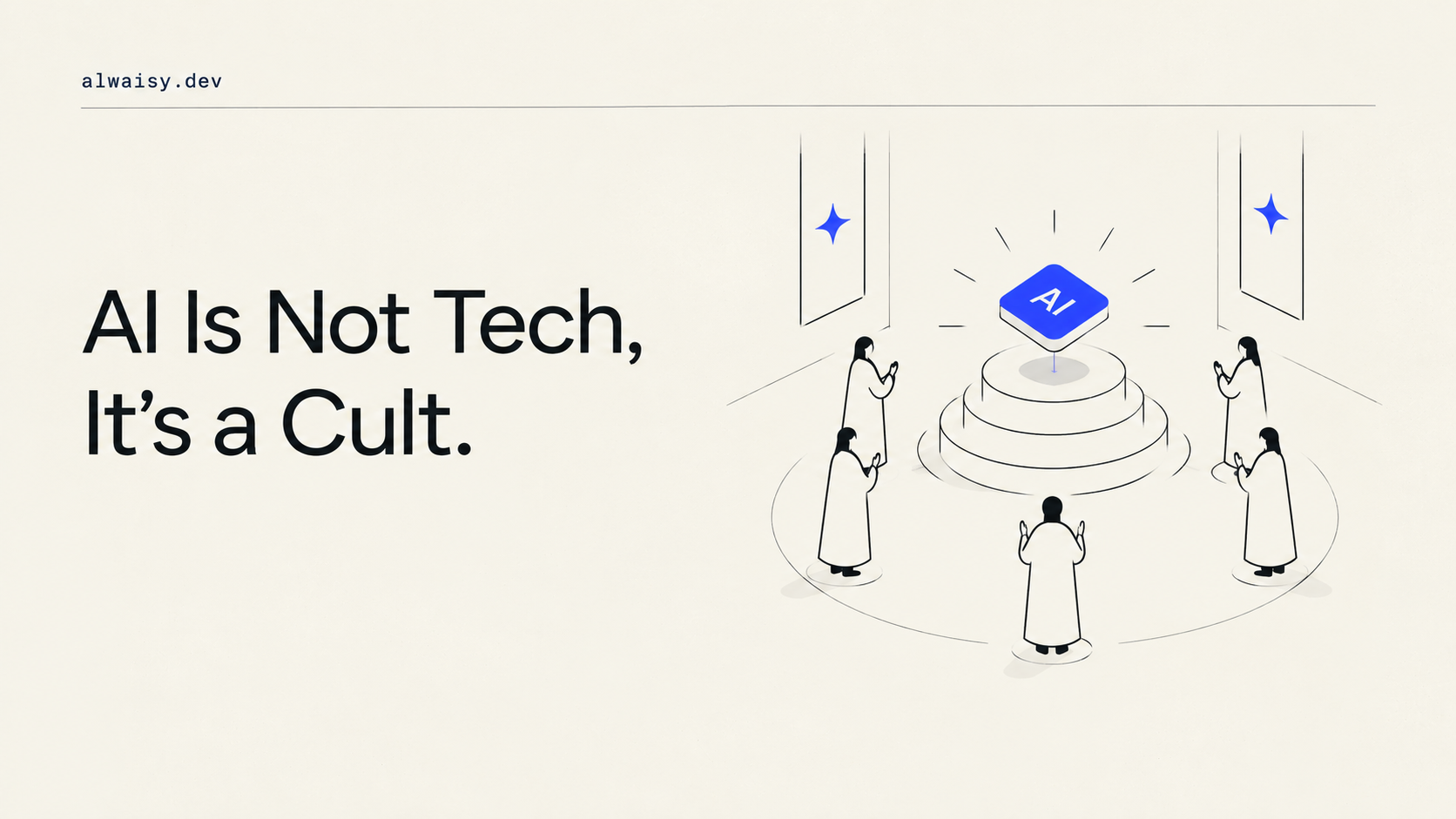
Every argument about AI stops being about AI. It took me a while to see it.
Here’s a simple test you can run on any tool. Ask it what it can’t do.
A hammer can’t cut glass. A database can’t think. And that’s fine, because you can measure a tool. You can argue about it. You can reach a conclusion. A tool has limits, and those limits are made of bits and atoms. They’re real.
Now try that same test on a belief. Go ahead.
The second you question it, the conversation stops being about the tool. It becomes about you. The person who dared to ask.
That’s what happened to AI. And I don’t think enough people have said it out loud. AI stopped being a technology conversation a while ago. It’s a belief system now.
How To Tell A Tool From A Cult
Here’s a good way to spot it.
Point at the financials. Say frontier AI is heavily subsidized. You know what happens? You get called delusional. You ask for a counter-number, and you get a feeling instead. You bring up a study, and someone tells you you’re “not keeping up.” Or that you’re high on something.
Nobody checks the math. They check your loyalty.
See, a conversation you can reason your way through. A congregation, you can’t. And every AI debate I’ve read this year flipped from the first into the second in about three comments.
Now, I don’t use the word “cult” to be rude. I use it because it’s the right word for what happens when disagreement gets treated like heresy. And that is not a normal reaction to a piece of software.
Is AI Actually Eating Jobs?
Let’s start with the belief itself. It sounds like this:
AI is eating your job.
And honestly, it feels true. The tools are everywhere. The layoffs are real. The timing lines up. So almost nobody stops to check the cause.
But the cause is rarely the thing in the headline. Look at what actually drove the layoffs over the last few years:
- Companies over-hired during COVID and spent trillions doing it. Then the bill came due.
- One big company cut half its staff. The stock went up. Every board in tech decided to copy the move.
- Those same companies started rehiring for the same roles at half the salary.
That’s not an AI story. That’s a cost story.
Here’s the machine behind it. When interest rates go up, money gets expensive. When money gets expensive, cash gets tight. And when cash gets tight, companies stop taking risks. They stop expanding. They stop hiring.
That’s the real reason behind most of the job market right now. Not the model. The money.
And if you’re a developer outside the US, this hits even harder than the AI part. Our market is tied to theirs. We make money when they make money. When they don’t, we’re the first to feel it.
AI affects your job. But it’s rarely the reason. The reason is the money, and the money is nervous.
Why Subsidized AI Pricing Cannot Last
Now here comes the part that makes people angry. Which is usually how you know it’s worth saying.
The price you pay for AI is not what it costs to run. Those are two different numbers. And the gap between them is the whole story.
OpenAI and Anthropic are burning cash on purpose. It’s the same play as every blitzscaled company before them. Lose money now. Own the market later. Jack up the price once you’re too big to leave. Except this time the numbers are wild.
We’re talking trillions already spent. Hundreds of billions more planned. Most of it borrowed, and all of it collecting interest at rates that keep climbing. A big chunk of that debt starts coming due around 2027.
And here’s the trap. They can’t drop prices to win, because the debt won’t let them. Their pricing can’t go low enough to cover it. So the only way out is to charge the people already inside the garden a little more.
Which means the subsidy was never a gift. It was a down payment on your future bill.
When that gap finally closes, you don’t get a clean reset. You get a correction. Investors write it down. And the risk gets socialized, which is a polite way of saying the public pays for it. Last time, in 2008, the US chose inflation. Nobody got a vote.
Meanwhile, four years in, the productivity gains they promised still aren’t showing up in the real numbers. And that silence is louder than any keynote.
Why AI Became A Belief System
So why can’t people just look at the numbers and talk?
Because for a lot of people, this isn’t a position. It’s an identity.
If your company, your career, your savings, or your sense of being one of the smart ones is riding on AI being the future, then doubt isn’t a debate. It’s a threat. And when people feel threatened, they don’t trade facts. They defend the walls.
You’ll spot the pattern once you know what to look for:
- Fear. Adapt or die. You’re already behind. The ones who don’t use it will get replaced.
- Salvation. This time is different. Everything changes soon.
- Leaders who can’t be wrong, no matter how often they are.
- And policing. People who try to convert you. People who attack the messenger the moment they can’t attack the message.
A tool doesn’t need evangelists. A belief does.
What AI Hype Costs Solo Builders
Now here’s the part I actually care about, because most of you reading this are building something alone.
If you hand your thinking over to a system you don’t understand and can’t question, you become the easiest thing in the world to replace. Act like a bot, and you’ll lose to a bot every time. It’s faster. It’s cheaper. And it doesn’t need sleep.
The work that survives is the work a model still can’t do:
- Judgment. Deciding what to build, and more importantly, what to kill.
- Architecture. Holding a whole system in your head and knowing where it bends.
- Taste. Knowing when something is actually finished.
- And anything that can’t be written as text, because text is the only thing these systems truly understand.
Notice what all four have in common. They need you to think. That’s the exact skill the cult asks you to hand over.
How I Use AI Without Joining A Cult
I use AI every day. It writes a chunk of my code. It helps me research. It saves me hours of busywork. I’m not telling you to unplug.
I’m telling you to use it like a tool, and skip the church.
- Keep your thinking sharp. Question the claims, especially the ones that flatter you.
- Learn where AI is weak, and plant yourself there.
- Save like the cycles are real, because they are. The 80s. The dot-com crash. 2008. Then the easy run from 2012 to 2022. We’re in a downturn now, and downturns reward people with cash and calm.
- Take the long view. The people who get wrecked by these cycles are the ones who think the current moment is permanent. It never is. Not in either direction.
The worst part of a bubble isn’t the crash. It’s how many people quit right before the thing they were scared of stopped being true.
My Take
I could be wrong about the timing. I’m a builder, not an economist, and I won’t pretend otherwise. Nobody knows exactly when the money runs out.
But I’m sure about one thing. AI is a tool. And tools don’t need faith.
So when someone tells you to believe, that you’re behind, that it’s all over, that you have to commit fully or get left behind forever, stop. Ask for the numbers.
A tool will answer. A cult won’t.
I write about solo founders and how they survive markets like this one. If you read the math differently, I’d genuinely like to hear it. Hit me up.
